
​​“You Don’t Build Bridges to Safe and Familiar Territories”: Study Abroad Practice Based in Reconciliation as Falling Apart (Part I)

by Kalyani Unkule

Part I

This three-part series of articles draws on critical engagement with the concept of reconciliation and its discontents as part of the author’s on-going work via the Employing Study Abroad for Peace and Reconciliation Project (under the Commonwealth Peace and Reconciliation Challenge Grant, Association of Commonwealth Universities). Transitional justice is laden with the same vocabulary of “addressing institutional gaps” by exporting “best practice” and ultimately “building capacity” that plagues parlance in international higher education. Since these terminologies uphold a hegemonic standard expected to be emulated by all, in both fields “catch-up” for some seems always aspirational, never realized. Transitional justice scholars and practitioners, like their counterparts in international higher education, are looking for ways to nourish their fields with plurality by making room for context. Both fields, in recent memory, have initiated the process of confronting entrenched interests and the monocultures of practice that eclipsed their worthy original goals. Anzaldúa’s (2002, p. 3) imagination of bridging as “the work of opening the gate to the stranger, within and without” is channelled to outline an alternative paradigm of international education grounded in justice. Part I of this series surveys critiques of experiments in reconciliation conducted around the world to find that they have left continuity of hegemonic worldviews and sociability unchallenged. The aim is to relate a new understanding of reconciliation with higher education internationalization practice, particularly study abroad, drawing on Anzaldúa’s (2002, p. 3) imagination of bridging as “the work of opening the gate to the stranger, within and without.”

Anzaldúa’s Nepantla is the dialogic space of in-betweenness between discord and harmony. At the epistemic level, in-betweenness (Nepantla) reconstitutes borderlands as the refuge of the critical gaze. In lived experience, perhaps, it is a form of resistance to semiotic foreclosure, thereby being eminently transferable to self-assessment of learning through study abroad. Nepantla inspires the quest for that stranger which resides within us, thereby problematizing facile modalities of othering. My aim here is to explore why this could be a way to attempt reconciliation beyond simply discovering relative truths. I examine the implications of reframing study abroad and international education as building bridges to that which is unknown about ourselves and our contexts, through contact with diverse situations and scenarios, as a departure from the commonly encouraged purpose of knowing about “others.”

Reframing Reconciliation as In-betweenness

Transitional justice is concerned with rebuilding of institutions in the wake of violent conflict and other major disruptions. Reconciliation or restoring trust in social relations is an important component of this process. Since “anti-colonial struggle was written out of transitional justice from its very beginning” (Kurze & Lamont, 2021, p. 158), reconciliation has chiefly been attempted as a conservative enterprise in burying the hatchet. As a result, “transitional justice scholarship operates at a positivist level, or trying to explain certain, and desired, outcomes rather than destabilizing and unsettling unequal power relations” (Kurze & Lamont, 2021, p. 155). Yet, in its thick conception, reconciliation entails opening up to other ways of being. In this sense, it has the potential to bridge the anti-oppressive and decolonial perspectives, which Stein (2021) regards as two separate strands of critical discourse on higher education internationalization.

The epistemological agenda of the anti-oppressive strand is to ensure institutions of learning emphasize equality in all areas of learning. By implication, this strand’s ontological concern is with valorising and rewarding other ways of being (see Stein 2021). The decolonial strand, at the level of knowing, problematizes ascriptions of universality to western modernity. Where knowledge creation and dissemination are concerned, the decolonial paradigm, particularly influenced by Indigenous approaches, grapples with boundary questions about how far the remit of positivist science even legitimately extends. Reconciliation is ultimately about being together but the varied experiences of attempts at achieving it surveyed here and in subsequent parts remind us of the real issue at stake: are other ways of being accounted for in reimagined futures or is reconciliation the vehicle for ossification of the hegemonic worldview?

Reconciliation at its core is about acknowledging reciprocal truths with the idea of leaving injustices behind to secure continued coexistence. On a broader level, reconciliation entails reparative justice with interventions focused either on individual or collective grievance. These interpretations of reconciliation are problematic because: a) they make reconciliation contingent upon the goodwill of the state/the dominant group/those responsible for wrongdoing and b) they ultimately contribute to strengthening existing structures via co-option of the aggrieved. Hence, reconciliation in a profound sense must be about re-establishment. Not only does this understanding fully acknowledge the indispensability of self-determination, but it also goes to the socially constituted and systemically perpetuated nature of harm. In Anzaldúa’s (2002) own words:

“Bridges are thresholds to other realities, archetypal, primal symbols of shifting consciousness. They are passageways, conduits, and connectors that connote transitioning, crossing borders, and changing perspectives. (…) Transformations occur in this in-between space, an unstable, unpredictable, precarious, always-in-transition space lacking clear boundaries. […] living in this liminal zone means being in a constant state of displacement—an uncomfortable, even alarming feeling.” (p. 1)

Thus, Nepantla underscored the need for a mindful approach to this intended transition.

Reconciliation, thus reframed as in-betweenness, is undertaking brick-by-brick the arduous work of building bridges back to ourselves. In earlier work (Unkule, 2018), I have reimagined study abroad as an undertaking in studying one’s own context rather than an exercise in further essentialising and particularising the other (in a bid to attain “cultural competence”), ultimately enabling us to see all beings as oneself. According to Anzaldúa (2002, p. 2), where once the struggle was about recognition of difference, “today we grapple with the recognition of commonality within the context of difference.” The idea of witnessing may be deployed to clarify the operative, tactical, and pedagogical aspects of enabling such learning and transformation through study abroad. Nagy (2020, p. 221) sees potential in the discomfort produced by survivor testimony – akin to the unsettling that in-betweenness triggers – not merely “reckoning” but beyond that for “transformation of Indigenous-settler relationships.”

Correspondingly, study abroad practice must step away from a comfort zone erected around facile associations of experiential learning with development of intercultural competence, unexamined hypotheses about diversity automatically ensuring expression of diverse viewpoints, and the conflation of training to develop a tolerant (woke) manner without fundamentally recognising the politics of knowledge creation. What the practice needs, in other words, is an epistemic and cognitive break – a falling apart – driven by the realization that learned superiority and inferiority need to be unlearned before intercultural dialogue is attempted – just as international higher education can assume a reparative stance only after divesting from systems that perpetuate extraction and exploitation as the first step.

Part two of this series will outline three possibilities for reconstituting study abroad with an emphasis on reconciliation understood as in-betweenness.


References

Anzaldúa G.E. and AnaLouise Keating (Eds.). (2002). This Bridge we call Home: Radical visions for transformation. Routledge.

Kurze, A., & Lamont, C. K. (2021). Breaking the Transitional Justice Machine: Exploring Spatiality, Space Travel, and Inbetween Spaces in Research Practice, Political Anthropological Research on International Social Sciences (PARISS), 2(1), 155-178. doi: https://doi.org/10.1163/25903276-bja10019

Nagy R. (2020). Settler Witnessing at the Truth and Reconciliation Commission of Canada, Human Rights Review, 21, 219–241. https://doi.org/10.1007/s12142-020-00595-w

Scott C & Tuana N. (2017). Nepantla: Writing (from) In-Between, Journal of Speculative Philosophy, 31(1), 1-15. DOI: 10.5325/jspecphil.31.1.0001

Stein S. (2021) Critical internationalization studies at an impasse: making space for complexity, uncertainty, and complicity in a time of global challenges, Studies in Higher Education, 46:9, 1771-1784, DOI: 10.1080/03075079.2019.1704722

Unkule, K. (2018). Seeing All Beings as Oneself: Internationalizing Higher Education for Universal Harmony. Frontiers: The Interdisciplinary Journal of Study Abroad, 30(1), 33–41. https://doi.org/10.36366/frontiers.v30i1.402

About the Author

Kalyani Unkule is Associate Professor at O.P. Jindal Global University in India. Her research complements her practice in intercultural dialogue and impact-driven projects in higher education internationalisation and spiritual learning. She can be reached via email at kalyani.u7@gmail.com 

RADARS for problematic patterns of curriculum internationalization

by Sharon Stein

Internationalization efforts are characterized by common problematic patterns that tend to reproduce systemic inequities, especially between dominant and marginalized communities. This tool offers one way of identifying these patterns in our theories and practices of internationalization – including those of us working with a critical lens. Indeed, critical internationalization studies is not immune from reproducing these patterns, in spite our ‘good intentions.’ This tool is not intended to point fingers or elicit guilt, but rather to support the development of deeper discernment to notice when these patterns are at work in ourselves and others, and to learn how we might interrupt and even avoid these patterns in generative ways that can move us in more accountable directions.

Redemption-seeking – Acting from a place of wanting to look, feel, and be seen as good (having one’s innocence or benevolence affirmed), rather than from a place of responsibility for complicity in epistemicide, and respect for the gifts of marginalized ways of knowing and being.

  • Disposition to develop: Complicity – Accepting that responsibility for individual and structural implication in system violence does not go away once one takes a critical stance.
  • Questions for self-/institutional-inquiry: What is motivating the effort to internationalize my curriculum?How might I be making this about me, rather than about addressing the impacts of historical and ongoing epistemicide, and engaging the gifts (and limits) of all ways of knowing and being? How might my own assumptions about my ‘good intentions’ be part of the problem I am trying to address? What do I do when I make a mistake in relation to my efforts to engage and incorporate non-Western knowledges? How am I accounting for possible resistance, and creating scaffolding for respectful student engagements with these knowledges, rather than simply including them as a means to signal my criticality?

Appropriative – Claiming mastery and expertise over a knowledge system that one has not been socialized into, particularly when that knowledge system and its knowledge keepers have been systemically marginalized and oppressed by one’s own knowledge system.

  • Disposition to develop: Respect – Recognizing the depth, complexity, and internal integrity of all knowledges, and the violence of claiming ownership over others knowledge systems.
  • Questions for self-/institutional-inquiry: Am I engaging other knowledge systems from a place of respect, reciprocity, and humility, and inviting my students to do the same? How might members of marginalized knowledge communities view these engagements?  How might my engagements play a part in the further colonization and commodification of these knowledges? How can I support the continued production and transmission of marginalized knowledges by members of those knowledge communities, especially their elders, both materially and in other ways, both within higher education and beyond?

Depoliticizing/dehistoricizing – Ignoring or minimizing the ways that different knowledge systems hold unequal institutional power in systemic, historical, and ongoing ways

  • Disposition to develop: Contextualization – Attending to and attempting to interrupt the colonial dynamics that shape how knowledges are differentially received and valued
  • Questions for self-/institutional-inquiry: How has my field/discipline participated in/benefited from colonial violence (material and epistemic)? How has my institution participated in/benefited from colonial violence? How are non-western knowledges generally received and valued in my field and institution? How can I interrupt the systemic, historical, and ongoing unequal epistemic power of different communities in my courses, my department, my field, and my institution? How am I responding to the fact that my racialized and Indigenous colleagues receive pushback from white colleagues and white students for teaching from their own knowledge traditions?

Additive – Including a few elements of non-western content in in a tokenistic fashion, often as an afterthought, in order to ‘tick’ the box of internationalization

  • Disposition to develop: Integration – Thoughtfully integrating different knowledges and ways of knowing throughout the entirety of a course, project, or program in intentional ways that significantly impact its overall direction, intention, and outcomes.
  • Questions for self-/institutional-inquiry: How can we attend to the need for deeper transformation across our programs, rather than it being confined to a single course or reading or program? What are the risks involved in these efforts? What kinds of policy and practice changes do we need at the departmental and institutional levels in order for more substantive and equitable integration to be possible? What might have to be decentered/de-emphasized to create space for other knowledges and perspectives? How are we preparing for or pre-empting possible backlash against these efforts, particularly in ways that shield the most vulnerable who are often the targets of this backlash?

Reductive – Reproducing and renaturalizing narratives and representations that homogenize and objectify whole communities, peoples, and knowledge systems (whether in negative, pathologizing ways, or in “positive,” romanticizing/idealizing ways).

  • Disposition to develop: Complexity – Holding space for the internal complexities, nuances, contradictions, heterogeneities, and tensions that are present in all communities, peoples, and knowledge systems, including marginalized ones.
  • Questions for self-/institutional-inquiry: How might my own narratives, and the representations that I chose to include in the course, about non-western communities, people, and knowledge be reproducing uni-dimensional and stereotypical representations? What are the different dangers of pathologizing narratives and romanticizing narratives? How can I acknowledge and engage the complexities, nuances, contradictions, heterogeneities, and tensions that are present within all communities and the individuals within them? How am I attending to the ways that these the complexities, nuances, contradictions, heterogeneities, and tensions of non-western communities can be weaponized to rationalize continued western epistemic hegemony and other violences, and therefore being cautious about when and how they are introduced and addressed?

Selective engagement – Extracting and decontextualizing non-Western knowledges (epistemologies) from their ontologies, in order to fit them into Western frames/narratives

  • Disposition to develop: Humility – Understanding that one cannot become an ‘expert’ in a knowledge system one was socialized outside of, and recognizing the risks of reading other knowledges through one’s own frames in an ethnocentric way. 
  • Questions for self-/institutional-inquiry: How am I encouraging students to hold space for what they might not understand or might be missing when engaging other knowledge systems? How am I encouraging students to attend to how unequal epistemic power, as well as Western epistemic arrogance, can shape how other knowledges are received? How can I encourage students to encounter knowledges from a place of humility about their ability to comprehend them, as well as a willingness to be surprised or confused by them, rather than a will to ‘understand’? How am I encouraging students to consider what is lost, but also what harmful patterns might be reproduced, when we presume that we can understand?

Open letter regarding adoption of the SDG framework for sustainability

by Sharon Stein, Vanessa Andreotti, and Cash Ahenakew

Recently, we wrote an open letter in response to our institution’s plan to adopt the UN Sustainable Development Goals (SDGs) as its primary framework for sustainability. We are sharing the letter here, in case it is useful for others facing similar institutional proposals. You can read the full letter here: https://blogs.ubc.ca/sdgopenletter/

Excerpt here:

While we strongly support the university’s overall direction toward greater allocation of attention and resources to issues of sustainability and societal impact, we also urge caution about the uncritical adoption of the SDGs and advocate for the importance of ongoing critical and reflexive engagements with the complexities, paradoxes, and nuances of the SDGs and indeed all sustainability efforts. It is only in this way that we might ensure more socially and ecologically accountable responses to inequalities and climate change that keep in view both the inherent unsustainability of our current socio-economic system, as well as the systemic, historical, and ongoing colonial violence that underwrites that system.

If we do not preserve space for these engagements then even well-intentioned sustainability efforts will likely reproduce all-too-common colonial practices including unequal, paternalistic and extractive relationships between dominant and marginalized communities, simplistic solutions to complex problems, and ethnocentric imaginaries of justice, responsibility, and change.

We are concerned about the framing of this proposal, which emphasizes UBC’s global leadership in sustainability, and in particular its high placement in the Times Higher Education rankings based on the SDGs. While there is nothing wrong with celebrating UBC’s accomplishments, it becomes worrisome when these accomplishments are framed as the primary rationale for adopting a particular framework – as is indeed the case with the report, which names this as the primary benefit of this proposal. Too narrow of a focus on rankings, leadership, and UBC’s “brand and reputation” may compromise our ability to maintain a university environment in which critically-informed, rigorous scholarly deliberations about social and institutional sustainability efforts can occur. This should also include deliberate engagements with divergent perspectives. How can we ensure that, with the adoption of the SDG framework, alternative visions of sustainability, and of development, will be welcomed and actively encouraged at UBC?

Happier, healthier, wealthier?

By Sharon Stein and Vanessa Andreotti

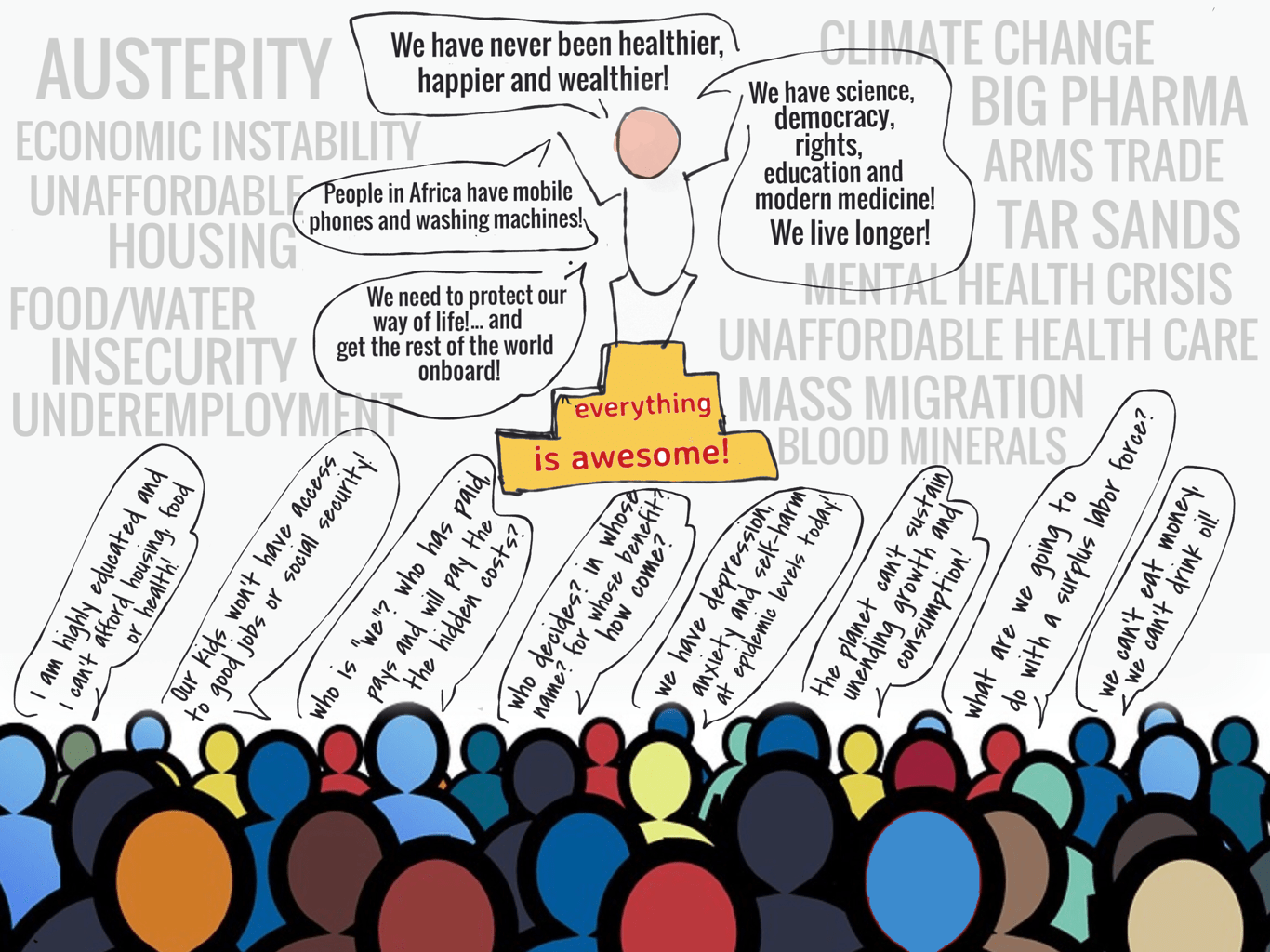
The image that leads this post, which we describe as a kind of cartography, was inspired by an international education conference that we recently attended. When we first learned that the conference theme was entitled,  “Things we should be talking about in international education,” we were excited about possible openings for the kinds of reflexive, complex, and difficult conversations that we had been advocating for in the context of international education. The conference invitation noted about the international education sector:

“Our sector casts a long shadow and there may be other things we should be talking about: climate change and the culpability of our sector with its large carbon footprint; how globalization and its well-intentioned offspring internationalization have spawned the populism and nativism we are so offended by; fake news and the abhorrent lack of inculcation of critical thinking; how cosmopolitanism, inter-culturalization and indigenization have on the streets already overtaken internationalization as prima facie rationale for what we do; housing, mental health, campus suicides, student support and stewardship; culture, sexual assault and predatory behaviour; nature vs. nurture and male violence, the great majority of which is directed towards other males; regional growth and rural engagement; our addiction to unsustainable growth; reconciliation and residential schools; fentanyl, opioids and binge drinking; our complicity in the brain drain, the scourge of globalization; our culling of the top economic strata from the global South’s burgeoning middle classes (our emerging markets) to fill our classrooms, quotas and coffers; our wilful ignorance of the demography and elitism of study abroad, building programs and pedestals for the 1% to springboard their careers.”

While this text and the tone of the conference’s opening session gestured toward pressing ecological, economic, and political challenges, and the potential for international education to either mitigate or worsen these challenges, by midday the orientation of the conference turned sharply toward emphasizing unprecedented levels of wealth and well being, with the only perceived challenges being the possible interruption of the continued spread of this good news gospel and its accompanying material gifts. This tone continued with the keynote presentation of a prominent Canadian politician.

The tone of the keynote sounded eerily like the “Everything is awesome” song from the Lego movie, also echoing a refrain that has also been recently articulated by those seeking to reframe a seemingly endless stream of bad news and concerned assessments about the many challenges of the present.

Perhaps the most well known of these recent texts is Stephen Pinker’s Enlightenment Now, which Bill Gates has declared as his “new favorite book of all time.” From the book publisher’s description, in this book, “Pinker shows that life, health, prosperity, safety, peace, knowledge, and happiness are on the rise, not just in the West, but worldwide. This progress is not the result of some cosmic force. It is a gift of the Enlightenment: the conviction that reason and science can enhance human flourishing.”

While for some this text is a welcome intervention, it has also been met with a series of critical responses. With this image, we offer a pedagogical cartography of responses to the assertion that “everything is awesome”, through which we seek to invite active engagement with the blindspots of this assertion in ways that might supplement the more point by point accountings of its inaccuracies and oversights. To illustrate the possible uses of this cartography, in addition to the image itself, we offer a series of possible guiding questions for educational engagement around the issues it addresses.

The image shows a speaker on a podium making declarations about the overwhelmingly positive state of the world, while  voices below him raise various concerns that contest his depiction of reality. This is not meant to be a comprehensive representation of all possible responses, but rather a selection of replies that would likely be most legible, if perhaps disagreeable, to the speaker. Indeed, there are many more voices that would likely be unintelligible to the speaker. One way to engage people around this image in a way that extends and complexifies what is already represented, might be to ask:

  • For those who agree with the speaker, what does his perspective offer?
  • Which/whose dissenting voices are likely to be intelligible to the speaker, and why;
  • Which/whose dissenting voices are unintelligible, why, and what might they be saying;
  • What are the effects of this selective hearing?

Similarly, the list of disavowed issues that surround the speaker is hardly comprehensive, so it can be generative to ask which issues are missing, and which are the most important in their own context.

By creating an opportunity to ask where different positions come from, what they presume, where they lead, what they enable, what they foreclose, and which positions remain absent or invisibilized, social cartographies can challenge presumptive authorities without either seeking to replace them with a different authority or advocating an absolute relativity of positions. Further, by challenging learned desires for consensus, coherence, and quick resolution, cartographies can help build the stamina that is necessary to sit with the contradictions, complexity, uncertainty, and ambivalence that are involved in learning and unlearning ways of knowing, being, and relating with and in the world. Ultimately, rather than prescribe solutions, this supports people to make their own (better informed) decisions about how to respond to complex global challenges within their own situated contexts.

Download image here.